“The most frightening thing in the world is our own self”
Blind Willow, Sleeping Woman“The most frightening thing in the world is our own self” is the night-watchman’s conclusion after confronting a hostile version of himself in a mirror that never existed. The expression turns a seemingly supernatural fright into a recognition of inward terror: what appears to be an alien enemy is simply the self, and the revelation endures beyond the night that produced it.
The Mirror Encounter
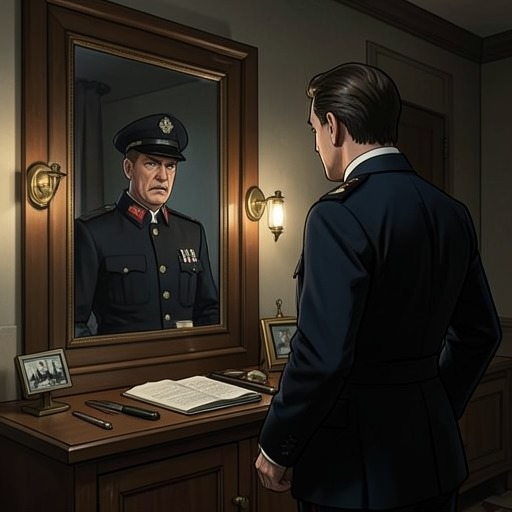
On a typhoon night, the watchman passes the entrance to a school and notices something in the darkness. He turns back with his wooden sword in hand and shines his flashlight toward the wall beside the shoe shelf. At first, the full-length mirror he finds there seems to resolve the disturbance. It was not present the previous night, he thinks, so someone must have installed it since then. Relieved, he feels foolish for being startled and lights a cigarette.
The ordinary scene does not hold. In the faint streetlight, with the swimming-pool gate banging behind him in the wind, he sees that the reflection looks exactly like him but is not quite him: it is another self, one that should never have been. The figure’s defining quality is hatred, imagined as something immense and undiminishable, like an iceberg afloat in a dark sea. The threat is frightening precisely because it has no obvious outside origin; it wears his face.
From Recognition to Terror
The watchman and the figure remain fixed in a mutual stare. His cigarette slips from his hand, and the reflected cigarette falls too. When the figure moves its right hand to its chin and slowly creeps its fingertips up its face, the watchman realizes that he is making the same gesture. The synchrony makes the reflection seem less like an apparition acting independently than a force taking control of his own body.
He breaks the paralysis by roaring and striking the mirror with his kendo sword. He hears glass shatter but does not look back; instead, he races to his room, locks the door, and gets under the covers. He remembers the cigarette left on the floor, but fear prevents him from returning for it. Outside, the wind continues to howl and the pool gate rattles until dawn. The passage carries the encounter from uncertainty, through the sight of the hostile double, to a desperate physical response; the final explanation does not erase the terror of having experienced it.
The Ending Reverses the Apparition
The story makes its explanation explicit: there never was a mirror. In the morning, after the typhoon has passed and the day has turned sunny, the watchman returns to the school entrance. The discarded cigarette butt and wooden sword are there, but the mirror is not. These surviving objects anchor the aftermath in the ordinary world while confirming that the surface on which the double appeared had no physical existence.
He consequently rejects the ghost explanation. What he saw was himself. That statement is the decisive turn in the expression: the fear is not finally assigned to a supernatural being, but to the self encountered as something at once familiar and alien. The ending settles the question of whether a real mirror stood in the hallway, yet it leaves intact the force of the watchman’s experience and the hatred he perceived in the other self.
A Fear That Continues
The watchman says that he can never forget how terrified he was that night and that remembering it brings the same thought to mind: “the most frightening thing in the world is our own self.” The wording gives his recollection a lasting principle rather than treating the episode as a fright that ended when the glass supposedly broke. Its emphasis falls on the self as the source of fear, not on an external monster or the storm outside.
The consequence persists in a practical form: he has no mirror in his house. He says that learning to shave without one was no easy feat. This detail makes the expression more than a dramatic last line; it connects the uncanny encounter to an enduring alteration of everyday life. The mirror is absent both from the school entrance in the morning and from the watchman’s home afterward, but the self he saw remains difficult to face.